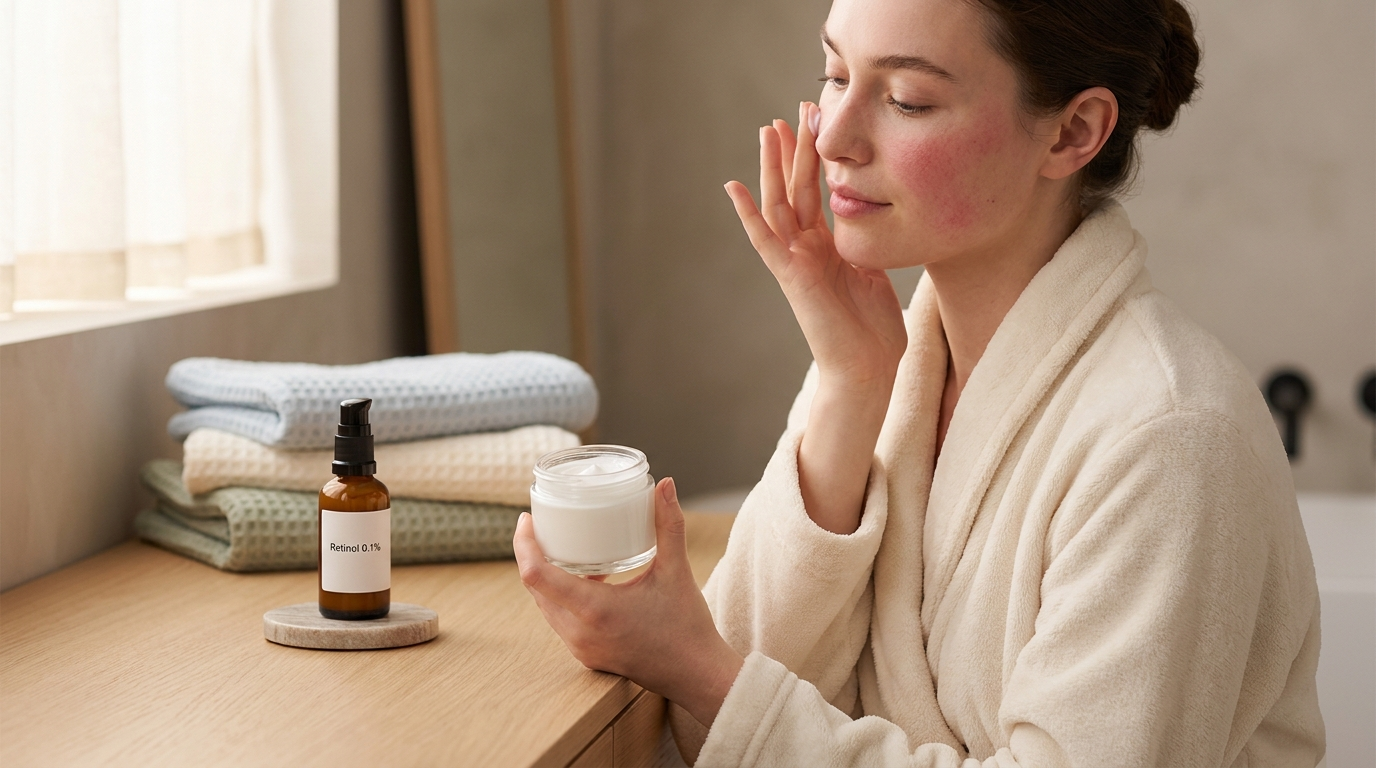
Sensitive skin does not always have to avoid retinol, but it needs a slower plan and a lower tolerance for warning signs. The goal is not to force your face through peeling. The goal is to find out whether a small amount of a mild formula can fit your routine while your skin barrier stays calm.
Can sensitive skin use retinol?
Some people with mildly reactive skin can use low-strength retinol with careful frequency and moisturizer. Others cannot use it comfortably. The American Academy of Dermatology advises caution for people with significant dryness, allergies, redness, or inflammation. A professional can help tell the difference between normal sensitivity, contact dermatitis, rosacea, eczema, and an impaired barrier.
Retinol is optional. Sunscreen, moisturizer, and gentle cleansing provide more basic value. If a retinol repeatedly causes a rash, you are not failing skincare by stopping it.
Choose the gentlest practical formula
Look for the lowest strength in the product line. Fragrance-free is a sensible preference for reactive skin. A cream or lotion with glycerin, ceramides, or squalane may feel more comfortable than a strong, fast-drying serum. Avoid first products that combine retinol with several exfoliating acids.
Do not assume that “clean,” “natural,” or “hypoallergenic” means reaction-free. Plant extracts and essential oils can irritate. Read the complete ingredient list and compare it with products you already tolerate.
Patch test before facial use
Follow the manufacturer's patch-test directions. A common approach is a small amount on clean skin of the inner arm for the time stated by the brand, then monitoring for redness, itching, swelling, or blistering. A patch test cannot recreate repeated use on the face, but it can catch an obvious reaction.
Do not patch test on damaged skin. If you have a history of strong cosmetic allergies, professional patch testing through a dermatologist is more useful than a home test.
A six-week sensitive-skin start plan
| Weeks | Frequency | Goal |
|---|---|---|
| 1–2 | One night each week | Check basic tolerance |
| 3–4 | Stay once weekly or move to twice weekly | Only increase if skin is calm |
| 5–6 | Two non-consecutive nights | Build consistency, not speed |
| After week 6 | Hold or increase slowly | Use the lowest effective frequency |
One night a week is not “too little” when it lets you stay consistent. Never increase during a dry, windy week, after sun exposure, or while another product is causing irritation.
Use the moisturizer sandwich
After gentle cleansing, let your face dry. Apply a thin layer of plain moisturizer, wait until it settles, then use a pea-size amount of retinol for the entire face. Follow with another layer of moisturizer. Put a little petrolatum on lip corners and nose creases first if those areas crack easily, but keep it away from areas where you do not want increased product spread.
Choose a moisturizer without exfoliating acids or a strong fragrance. A ceramide moisturizer selected for sensitive skin can be a useful partner.
Keep retinol away from high-risk areas
The eyelids, under-eye area, corners of the mouth, and folds around the nose are more likely to become irritated. Product can migrate after application, so leaving a small buffer is safer than placing it directly on every line. Wash your hands after application.
If you use contact lenses or have dry-eye symptoms, be especially cautious around the eyes and discuss persistent discomfort with an eye-care professional.
Build a quiet routine around retinol
Morning
- Rinse or use a gentle cleanser.
- Apply a plain moisturizer.
- Finish with broad-spectrum sunscreen.
Retinol night
- Cleanse gently and dry the face.
- Apply moisturizer.
- Use a pea-size amount of retinol.
- Apply another thin moisturizer layer.
Recovery nights
Use only cleanser and moisturizer. A hydrating serum is optional if you already know it is safe for your skin. Recovery nights are where sensitive skin often succeeds.
Ingredients to separate at first
Do not use strong alpha-hydroxy acids, beta-hydroxy acids, facial scrubs, peeling solutions, or another retinoid on the same night. Benzoyl peroxide can also be drying and may need a separate schedule. Vitamin C can stay in the morning if it is already tolerated, but do not introduce vitamin C and retinol in the same week.
Azelaic acid may be gentler than some acne actives, yet the combination can still be too much for reactive skin. Alternate routines and follow our azelaic acid use guide.
Retinol irritation or allergy?
Retinol irritation often shows as dryness, tightness, stinging, flaking, and redness in the areas where it was applied. It can appear after repeated use. Allergic contact dermatitis may include intense itching, swelling, or a rash that spreads beyond the application area. The two can overlap and cannot always be diagnosed at home.
Stop immediately for blistering, marked swelling, severe burning, eye involvement, crusting, or an oozing rash. Seek urgent care for breathing trouble or facial swelling. For milder dryness, pause retinol and return to a gentle routine until fully comfortable.
Peeling is not proof that retinol works
This myth pushes sensitive skin too far. A product can support gradual skin change without visible peeling. Peeling means the routine has exceeded what your skin can comfortably handle. Reduce frequency, use more moisturizer, or choose a milder product. Do not scrub flakes away.
When retinol is not the right next step
If your main concern is acne with significant inflammation, scarring, or hormonal symptoms, professional treatment may be more useful than trial-and-error cosmetics. If your main concern is dark spots, daily sunscreen and a gentler ingredient such as azelaic acid may be easier. If your main concern is dryness, focus on barrier support first.
Our guide to damaged skin barrier signs can help you decide whether now is the wrong time to introduce an active.
Pregnancy and breastfeeding
The AAD and ACOG recommend avoiding topical retinoids during pregnancy, including over-the-counter retinol. If you used retinol before knowing you were pregnant, stop and contact your obstetric clinician for personal guidance rather than relying on alarming social media posts. Breastfeeding advice can vary by product and application area, so ask your clinician.
How to tell if your skin is ready
For two weeks before starting, your face should tolerate cleanser, moisturizer, and sunscreen without stinging. There should be no active peeling, open areas, or hot red patches. If you recently changed cleanser or sunscreen, wait until you know those products are comfortable. A stable baseline makes a retinol reaction easier to identify.
Take a clear photo and write down current symptoms. Rate dryness, tightness, burning, and itch from zero to ten. Repeat the check the morning after retinol and again two days later. Sensitive-skin reactions can build slowly, so a comfortable first hour is not the only test.
What to do after mild irritation
Pause retinol until all stinging and flakes settle. Use lukewarm water, gentle cleanser, moisturizer, and sunscreen. Do not use an exfoliating acid to remove peeling. When skin has felt normal for at least one week, decide whether to restart at half the frequency, use a moisturizer sandwich, or choose a milder formula.
If irritation returns at the lowest frequency, accept that the product may not fit. Repeatedly injuring the barrier can create more redness and dark marks than the retinol is meant to improve.
Alternatives for common goals
For uneven tone or post-acne marks, azelaic acid or niacinamide may be easier. For dryness and fine dehydration lines, a ceramide moisturizer and sunscreen may deliver more visible comfort. For acne, a dermatologist can recommend an evidence-based treatment. For photoaging, daily sunscreen remains the highest-priority habit.
Peptide serums are another mild option for users focused on hydration and fine-line appearance, though their evidence is more formula-specific than retinoid evidence. The best alternative is not the trendiest ingredient. It is the one that addresses your goal without creating a new skin problem.
Our sensitive-skin rule
Comfort is a result. A routine that leaves your face calm, moisturized, and protected is already doing useful work. Retinol should earn its place by adding gradual benefit without taking that comfort away. Stay with the lowest frequency that works, and do not compare your schedule with another person's skin.
Frequently asked questions
Can people with sensitive skin use retinol?
Some can use a low-strength product at a low frequency. Active eczema, rosacea, marked redness, or inflammation requires professional guidance first.
What is the retinol sandwich method?
It means applying moisturizer before retinol and again afterward. This buffers the active and may reduce dryness.
Is peeling required for retinol to work?
No. Peeling is an irritation sign, not evidence of better results.
When should sensitive skin stop retinol?
Stop for persistent burning, swelling, blistering, cracking, eye irritation, or a worsening rash. Seek medical advice for significant symptoms.
Sources
Important: This article provides general education. A dermatologist can assess sensitive skin, eczema, rosacea, allergy, or prescription treatment needs.