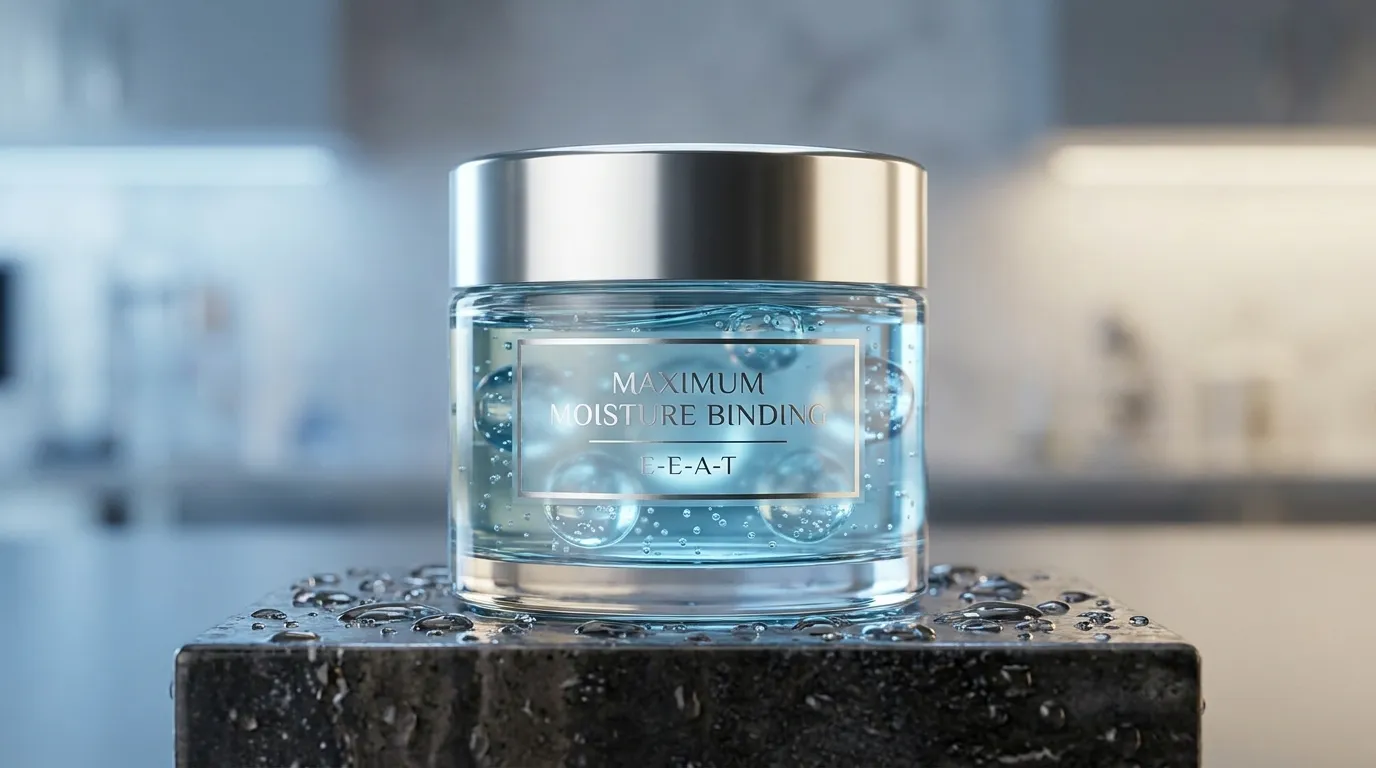
Hyaluronic acid is heavily marketed as a universal hydrating miracle, yet the vast majority of consumers unknowingly use it to their own detriment. In cosmetic chemistry, determining what is hyaluronic acid in skincare requires looking past the brand claims and examining the molecule's physical size and solvent dependencies. As a naturally occurring anionic glycosaminoglycan, it acts as the primary moisture-binding structural component within the human dermis. However, when formulated in a lab and applied topically, its efficacy is entirely governed by fluid dynamics, atmospheric humidity, and precise molecular weights.
Hyaluronic acid functions as an osmotic pump, capable of binding up to 1,000 times its weight in water. If you apply a poorly formulated hyaluronic acid matrix to a dry face in an arid environment, it will not hydrate your skin—it will actively dehydrate it by pulling water outward from your deeper dermal reserves. Mastering this compound means respecting its chemical constraints.
The Molecular Weight Paradox
A native hyaluronic acid molecule cannot physically penetrate the stratum corneum if its molecular weight exceeds 1,000 kilodaltons (kDa). For genuine structural hydration rather than a temporary surface film, a topical formulation must utilize a multi-molecular weight matrix containing both high (barrier-forming) and low (penetrating) molecular fragments.
The Biochemistry of Molecular Weights
When evaluating what is a serum in skincare, the delivery vehicle's physical density dictates its performance. Hyaluronic acid molecules are measured in Daltons (Da). The exact size of the molecule determines its functional depth within the skin matrix:
High Molecular Weight (HMW-HA)
Typically exceeding 1,000 kDa, these massive macromolecular chains remain completely on the outermost surface of the skin. They cannot bypass the lipid barrier. Instead, they form a breathable, viscoelastic film that significantly reduces trans-epidermal water loss (TEWL) and provides an immediate—though temporary—plumping effect that washes off completely at the end of the day.
Medium Molecular Weight (MMW-HA)
Ranging from 100 to 1,000 kDa, these molecules sink into the upper epidermis. They bind water between the corneocytes, effectively smoothing textural irregularities, calming localized inflammation, and supporting the suppleness of the stratum granulosum where the skin organizes its lipid scaffolding.
Low and Ultra-Low Molecular Weight (LMW-HA)
Measuring below 100 kDa, these micro-fragments possess the agility to penetrate deeply into the viable epidermis. They offer sustained, long-term hydration and actively stimulate fibroblast behavior, supporting natural collagen and elastin synthesis. However, if an ultra-low formulation drops below 10 kDa without proper buffering, it can occasionally trigger an inflammatory immune response.
Multi-Molecular HA Matrices
- 3D Cellular Hydration: Targets the surface, upper epidermis, and deep viable tissue simultaneously for comprehensive moisture.
- Sustained Efficacy: Prevents the "flash-drying" evaporation effect common with isolated, single-weight formulas.
- Barrier Repair: Low-weight fragments support cellular signaling while high-weight molecules form an occlusive environmental shield.
Single High-Weight HA Formulas
- Surface Trapping: Molecules are too large to pass the stratum corneum, offering absolutely zero internal cellular hydration.
- Polymer Pilling: Heavy HA chains frequently clump, flake, and pill when layered under complex makeup or mineral sunscreens.
- Atmospheric Dependency: In dry climates, large HA molecules will pull water directly out of your dermal reserves to survive, exacerbating dehydration.
Derivatives and INCI Labeling: What Are You Actually Buying?
You rarely see pure "hyaluronic acid" listed in high-end formulations due to its inherent instability and massive native size. Instead, cosmetic chemists utilize stable salt derivatives and synthetic analogues to manipulate epidermal penetration.
- Sodium Hyaluronate: The water-soluble sodium salt form of HA. It resists rapid oxidation and features a smaller molecular structure, making it the industry standard for cosmetic hydration.
- Hydrolyzed Hyaluronic Acid: These are HA chains that have been chemically cleaved (chopped) via hydrolysis into ultra-low molecular weights to guarantee deep epidermal saturation.
- Sodium Acetylated Hyaluronate: Frequently referred to in clinical settings as "Super Hyaluronic Acid." This form features acetyl groups that possess both lipophilic and hydrophilic properties, allowing it to anchor securely to the skin's lipid matrix, vastly increasing moisture retention time.
The Strict Application Protocol: The Damp Skin Imperative
A severe error in consumer application is applying a potent humectant to a bone-dry face. This practice remains one of the most destructive skincare mistakes to avoid. Because hyaluronic acid draws moisture from its surrounding environment, it must have an immediate water source to bind to. If your skin is dry and your ambient room humidity is low, the HA molecule will aggressively pull water upward from your deep dermal layers, leaving your skin feeling tight, papery, and compromised.
To establish a stable hydration loop, you must execute the following protocol:
- Cleanse the skin with a pH-balanced, non-stripping surfactant.
- Leave the face visibly damp—do not use a towel.
- Apply the hyaluronic acid serum directly to the wet skin, pressing it into the tissue until tacky.
- Immediately seal the humectant layer with an emollient or occlusive moisturizer.
Understanding how to layer skincare products correctly ensures that your water-soluble humectants are locked inside the tissue by a heavier lipid phase, preventing trans-epidermal evaporation.
Triple-Matrix Hyaluronic Acid 2% Complex
Best for Multi-Depth Cellular HydrationAn advanced micro-emulsion utilizing three distinct molecular weights of sodium hyaluronate alongside panthenol (Vitamin B5). Engineered to prevent surface pilling, the high-weight molecules smooth the stratum corneum instantly, while the ultra-low hydrolyzed fragments penetrate deeply to restore depleted intracellular water volume.
Integrating Hyaluronic Acid into a Minimalist Regimen
For patients overwhelmed by aggressive marketing campaigns, identifying the core necessities is vital. When evaluating what skincare products do I need, hyaluronic acid is technically classified as a secondary targeted treatment rather than a primary defense mechanism. However, for anyone experiencing age-related volume loss or chemical dehydration from acne treatments, a multi-molecular HA serum is the most biologically compatible formulation to rapidly rebuild a healthy tissue matrix.
Frequently Asked Questions
What is hyaluronic acid in skincare?
Hyaluronic acid is a naturally occurring glycosaminoglycan (sugar molecule) found in human connective tissue. In skincare, it is formulated as a powerful humectant capable of binding up to 1,000 times its weight in water, drawing moisture into the skin to increase hydration and structural volume.
What does hyaluronic acid do for the skin?
It physically binds water to the cells within the stratum corneum and viable epidermis. This process smooths out fine lines, instantly relieves feelings of tightness, accelerates barrier repair, and provides a visibly plump, highly reflective surface texture.
Should I apply hyaluronic acid on damp or dry skin?
Hyaluronic acid must always be applied to damp skin. Because it acts as an osmotic sponge, applying it to a wet face gives the molecule the water it needs to pull into the epidermis. Applying it to a dry face in a dry room will cause the molecule to extract water from your deep tissue, causing dehydration.
Is sodium hyaluronate the same as hyaluronic acid?
Sodium hyaluronate is the salt derivative of hyaluronic acid. While it serves the exact same hydration function, sodium hyaluronate has a much smaller molecular weight, allowing it to penetrate the skin barrier far more effectively than native, large-molecule hyaluronic acid.
What is the difference between high and low molecular weight hyaluronic acid?
High molecular weight hyaluronic acid is too large to penetrate the skin; it sits on the surface to form a moisture-locking protective film. Low molecular weight hyaluronic acid is chemically chopped into smaller fragments, allowing it to bypass the barrier to hydrate deep tissue and stimulate collagen repair.
Do I need to use a moisturizer after hyaluronic acid?
Yes, unconditionally. Hyaluronic acid is a humectant, meaning it holds water, but it possesses no lipids to seal that water inside the skin. If you do not apply an emollient or occlusive moisturizer over it, the water will rapidly evaporate into the atmosphere.
Can hyaluronic acid cause acne or breakouts?
Pure hyaluronic acid is naturally found in the human body and is completely non-comedogenic; it will not clog pores. If a hyaluronic acid serum causes a breakout, it is invariably due to the carrier ingredients, thickeners, or preservatives used in that specific formula, not the HA molecule itself.
Can I use hyaluronic acid with Vitamin C or Retinol?
Yes. Because hyaluronic acid is not a chemical exfoliant (despite having "acid" in its name), it does not alter skin pH significantly. It is universally safe to layer alongside potent actives like Vitamin C in the morning or Retinol in the evening to counteract the drying effects of those treatments.
Why does my skin feel tight after using hyaluronic acid?
If your skin feels tight or papery after application, you have experienced the "flash-drying" effect. This occurs when you apply a high-weight HA serum to a dry face without sealing it immediately with a lipid cream. The HA molecule has pulled moisture out of your skin and evaporated.
Are there side effects to using hyaluronic acid every day?
When formulated correctly, there are no side effects to daily use. It is a highly biocompatible molecule safe for twice-daily application. However, utilizing ultra-low molecular weight variants (below 10 kDa) in extremely high concentrations can sometimes trigger localized inflammation in hypersensitive skin profiles.