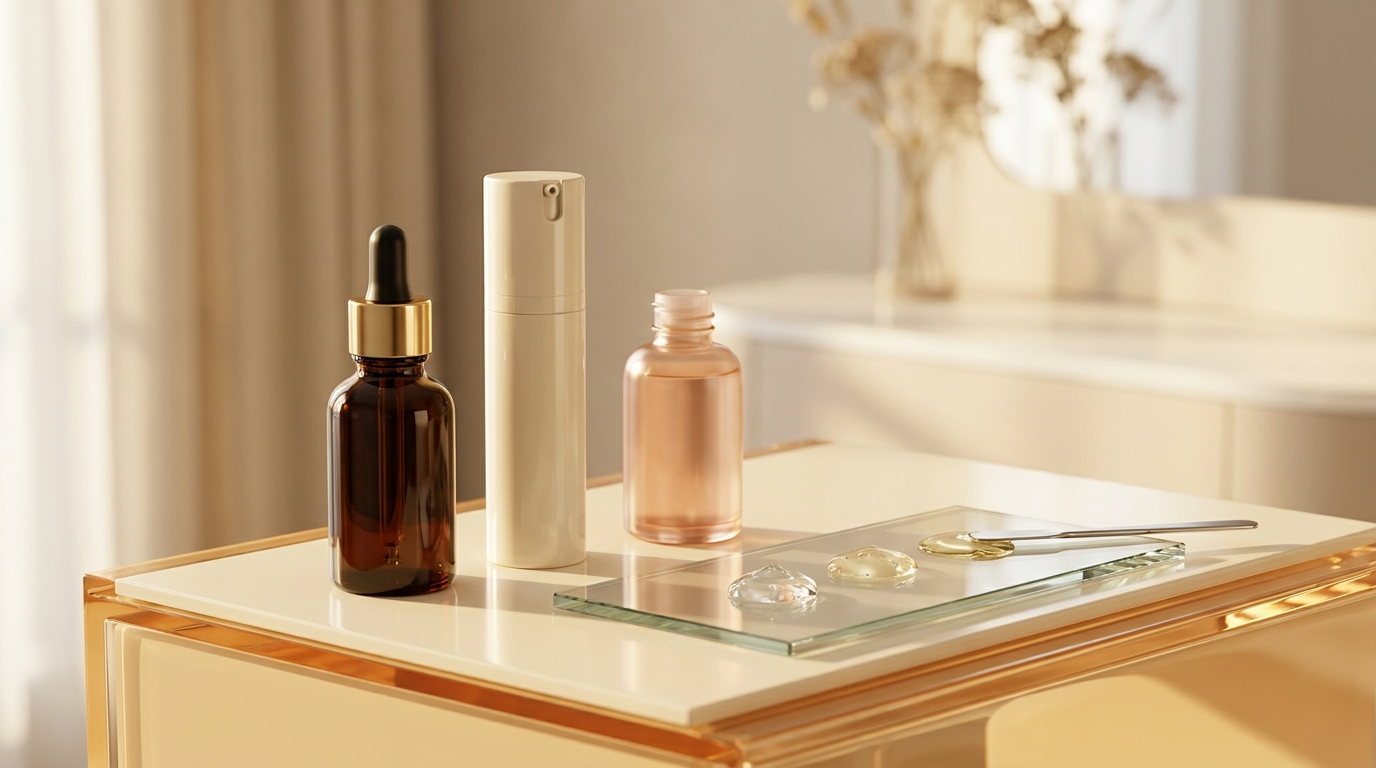
The best vitamin C serum is not simply the strongest bottle. A useful formula must keep vitamin C stable, place it in a base your skin can tolerate, and arrive in packaging you can protect. For one person that may be a 10% L-ascorbic acid serum. For another it may be a gentler derivative in a fragrance-free cream.
First learn the difference between ascorbic acid and derivatives in our guide to what vitamin C serum is and how it works.
Start with the vitamin C form
L-ascorbic acid is the form with the strongest direct research history. It is also difficult to stabilize and can sting because effective water formulas are often acidic. If your skin tolerates acids and your goal is established vitamin C evidence, an ascorbic acid serum may be a good match.
Derivatives such as sodium ascorbyl phosphate, magnesium ascorbyl phosphate, ascorbyl glucoside, 3-O-ethyl ascorbic acid, and tetrahexyldecyl ascorbate may offer easier stability or a gentler feel. They require different concentrations and cannot be ranked by percentage against L-ascorbic acid.
Our formula categories
Best classic antioxidant format
A water-based L-ascorbic acid serum combined with vitamin E and ferulic acid is a well-known design. It suits normal or oily skin that tolerates acidic products and wants a research-backed antioxidant combination. Look for dark packaging, a recent manufacture or expiration date, and clear storage guidance.
Watch for: stinging, a sticky feel, rapid color change, and a premium price that may not fit your routine.
Best lower-strength beginner format
A 5% to 10% L-ascorbic acid serum can be easier than a 15% or 20% product. Lower strength is not a guarantee of gentleness, but it reduces one part of the irritation risk. A formula with glycerin and minimal fragrance can make daily use easier.
Best option for sensitive skin
A fragrance-free derivative formula may be a better start than low-pH ascorbic acid. Vanicream Vitamin C Serum, for example, is positioned around tetrahexyldecyl ascorbate in a formula designed for sensitive skin. Confirm the current label because formulas can change.
Best option for dry skin
Look for a cream-serum or oil-soluble derivative with glycerin, squalane, ceramides, or other emollients. Dry skin can still use L-ascorbic acid, but the rest of the routine should include a reliable moisturizer.
Best option for oily skin
A light water serum or gel that dries without a heavy residue may fit better. Avoid assuming that alcohol-free always means light or that oil-free always means acne-safe. Test the complete formula.
Compare concentration correctly
For L-ascorbic acid, higher strength can increase irritation and does not guarantee more benefit. Clinical studies have used different formulas and concentrations, so there is no universal winning number. Derivatives use their own ranges. A 20% derivative does not automatically equal 20% active ascorbic acid in skin.
| Your priority | Formula direction | Main concern |
|---|---|---|
| Most direct research history | L-ascorbic acid | Stability and irritation |
| Sensitive skin | Gentle derivative, fragrance-free | Evidence varies by derivative |
| Dry skin | Cream-serum or emollient base | May feel rich under sunscreen |
| Oily skin | Light water serum or gel | Some formulas feel sticky |
| Simple storage | Stable derivative or airless package | Still follow expiration guidance |
Packaging checklist
- Opaque or tinted container for light-sensitive formulas.
- Airless pump or small opening to limit repeated air exposure.
- Clear storage and after-opening directions.
- A batch, manufacture, or expiration system you can understand.
- A size you can finish before it degrades.
A large bargain bottle is not a bargain if it turns dark before you can finish it.
Do vitamin E and ferulic acid matter?
They can support a well-designed antioxidant formula. Vitamin E is oil-soluble, while ferulic acid is another antioxidant. Research and formulation work have made the trio popular. A product does not need both to be useful, and their presence cannot rescue poor packaging or a formula that irritates you.
Fragrance and sensitive skin
Citrus scent does not prove a product contains useful vitamin C. Fragrance may make a serum pleasant but can add a trigger for sensitive or allergy-prone skin. Choose fragrance-free if you have a history of reactions. “Unscented” and “fragrance-free” do not always mean the same thing.
Product examples to understand the market
These are examples of different formula styles, not a permanent ranking:
- Timeless 20% Vitamin C + E Ferulic Acid Serum: a high-strength classic-style antioxidant formula; better suited to experienced, tolerant skin than a first-time sensitive user.
- CeraVe Skin Renewing Vitamin C Serum: a 10% L-ascorbic acid format with ceramides and a tube-style package.
- Vanicream Vitamin C Serum: a derivative-based, sensitive-skin-oriented approach.
- Mad Hippie Vitamin C Serum: a sodium ascorbyl phosphate formula with several supporting ingredients.
- La Roche-Posay Pure Vitamin C Face Serum: an ascorbic acid serum with a more complex ingredient list; check fragrance tolerance.
Verify the current U.S. ingredient list and official directions. A brand may reformulate without changing the product name.
How to test a vitamin C serum
- Patch test as directed.
- Use it every other morning for one week.
- Apply after cleansing and before moisturizer.
- Finish with broad-spectrum sunscreen.
- Track stinging, redness, darkening of the formula, and pilling.
Do not add retinol or an exfoliating acid in the same week. A stable routine makes product evaluation much easier.
How much should you spend?
Vitamin C is one category where packaging and stability may raise cost, but price still does not prove performance. Choose a bottle you can replace comfortably. Consistent sunscreen and a modest serum are more useful than an expensive antioxidant used too sparingly.
When vitamin C is not your first priority
If your skin is currently irritated, repair the barrier first. If you do not use sunscreen, solve that step before buying an antioxidant. If your pigmentation is changing, raised, itchy, bleeding, or one-sided, see a clinician instead of treating it as a dark spot.
How to compare value, not just price
Divide the price by the expected months of use, not only bottle size. A stable 30 mL serum finished in three months may provide better value than a 60 mL bottle that oxidizes halfway through. Include return policy, authorized seller, and storage needs. A formula requiring refrigeration may be inconvenient for travel.
Do not ration an expensive serum to one tiny drop if the label calls for more. Buying a product you can use correctly is more sensible than owning a prestige bottle.
How to avoid counterfeit or poorly stored products
Buy from the brand, an authorized retailer, or a seller with traceable inventory. Check packaging quality, seal, batch details, expiration information, and the brand's normal color. Vitamin C products stored in heat can degrade before reaching you. Contact the manufacturer when packaging looks wrong.
What to do when serum pills
Pilling often comes from too much product or several polymer-rich layers. Use fewer drops, let the serum dry, then apply moisturizer and sunscreen in thin layers. Pat instead of rubbing. If the sunscreen still rolls, move vitamin C to night or choose a thinner formula.
What to do when serum stings
Reduce frequency and apply to fully dry skin. Do not layer it with exfoliating toner. If the product causes lasting burning, swelling, or rash, stop. A lower percentage or derivative may be better, but wait until the barrier has recovered before testing another product.
A one-product comparison method
Use the chosen serum for eight to twelve weeks while cleanser, moisturizer, and sunscreen remain stable. Take monthly photos in equal light. Judge comfort, formula color, pilling, and progress on one concern. This method is slower than a haul, but it gives a clearer answer.
Our final buying order
First choose the vitamin C form. Second match concentration to experience. Third choose texture for skin type. Fourth check packaging and storage. Fifth compare price and return policy. If a product fails one of the first four steps, a discount does not make it the best choice.
Buy one serum, not a set. A stable test tells you more than using a toner, serum, cream, and mask from the same launch.
Write the opening date on the package and schedule a photo after eight weeks. This turns a vague beauty purchase into a controlled trial. If the serum stays comfortable and the target concern improves, keep it. If it oxidizes, irritates, or adds no value after a fair test, do not repurchase it simply because the brand is popular.
Frequently asked questions
What percentage of vitamin C serum is best?
There is no single best percentage. Higher-strength L-ascorbic acid can irritate more, and derivatives cannot be compared directly by percentage.
Is a clear bottle bad for vitamin C serum?
Light and air can affect some formulas. Opaque, tinted, or air-restrictive packaging is easier to protect.
Is vitamin C serum suitable for dry skin?
Yes. Choose a hydrating base and use moisturizer. Avoid combining several drying actives.
Does a vitamin C serum need ferulic acid?
No. Ferulic acid can support some formulas, but it is not required in every effective product.
Research and label references
Disclosure: Products are examples of formula types, not paid placements. Confirm current labels, availability, and prices before buying.